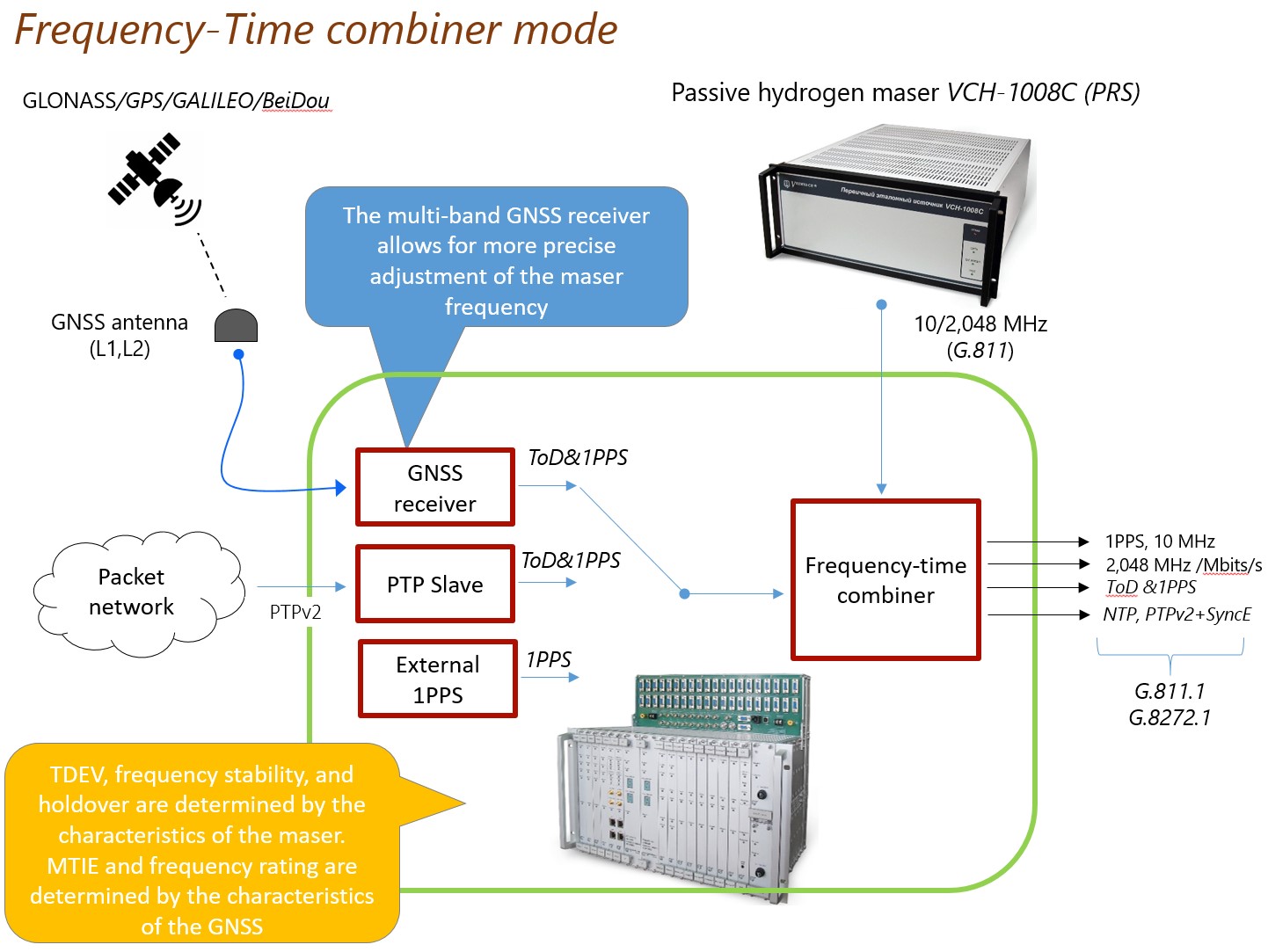

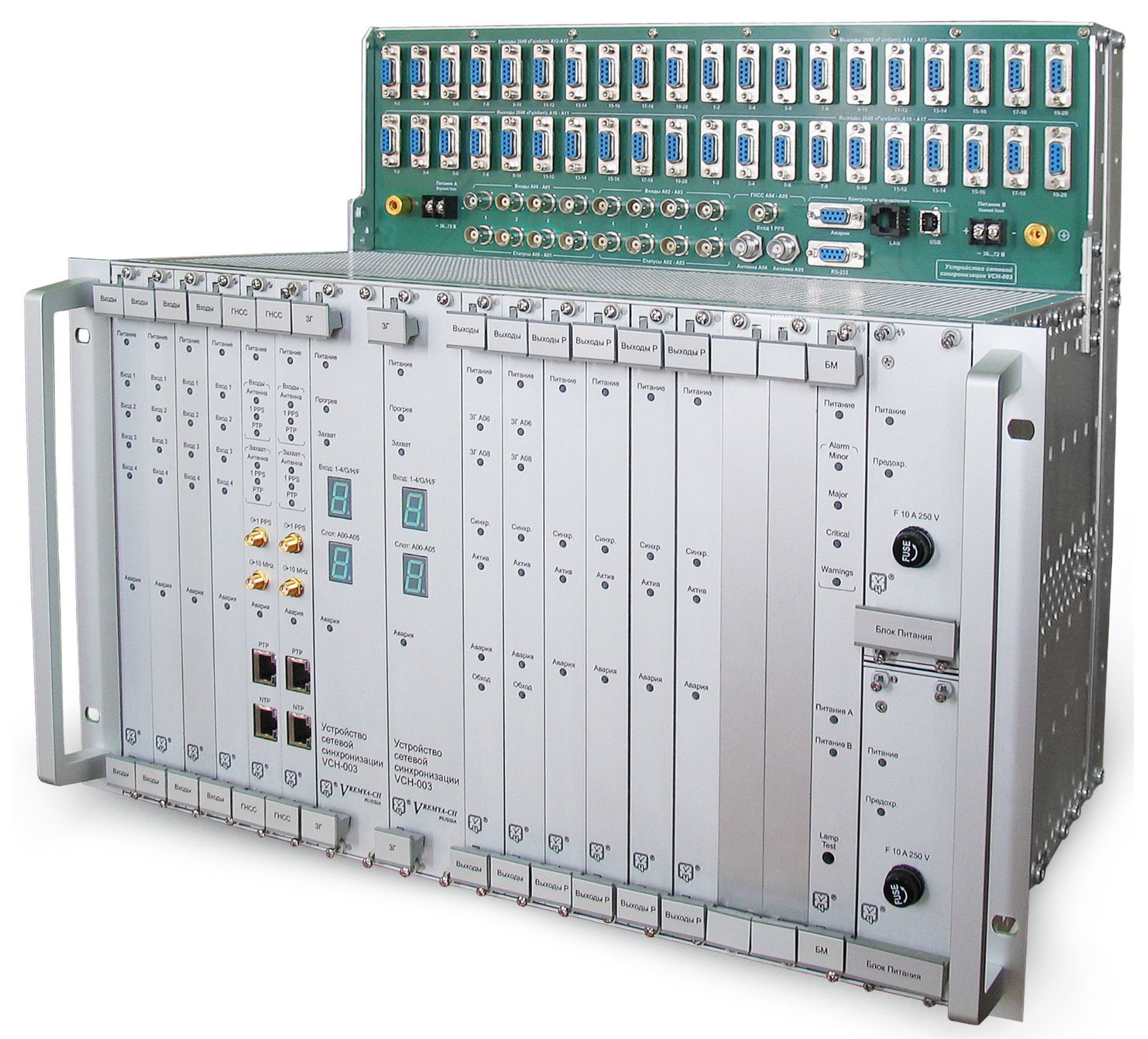
The VCH-003 Synchronization Supply Unit (SSU) is designed for use in Telecommunications Networks. Depending on its configuration, the VCH-003 SSU can be used to generate and distribute 2048 kHz and 2048 kbit/s synchronization signals as part of a Primary Reference Clock (PRC) system; to operate as a Transit Node Clock (TNC) or Local Node Clock (LNC), recovering synchronization signals derived from transmission lines at network nodes; or to generate synchronization signals using GLONASS/GPS GNSS references.
Primary Application
synchronization of digital telecommunications networks, SDH.
Key Features
– when used as part of an enhanced Primary Reference Clock (ePRC), the output synchronization signals comply with
ITU-T Recommendation G.811.1
.
– When operated as a Transit Node Clock (TNC) or Local Node Clock (LNC), the SSU complies with ITU-T Recommendation G.812.
– Reference frequency and UTC time combiner (ITU T G.811.1/G.8272.1).
– Up to 8 synchronization inputs:
2048 kHz, 2048 kbit/s (E1), 1 MHz, 5 MHz, and 10 MHz
.
–
1 PPS
synchronization input.
– Synchronization inputs from a
PTP Grandmaster (PTP GM)
.
– Multi-band GNSS GLONASS, GPS, BeiDou, GALILEO (L1/L2,E1/E5, B1/B2).
– Spoofing detection.
– Synchronization from
GNSS
signals; in this mode, the output synchronization signal characteristics comply with
ITU-T Recommendation G.811
.
– Automatic validation of input synchronization signals.
– Monitoring of input signal parameters
MTIE, TDEV, dF/F
.
– Time synchronization via
NTP
and
PTP
protocols in Master/Slave modes, with
SyncE
support.
– high-stability internal
quartz crystal (DOCXO) or rubidium oscillator
.
– Internal DOCXO aging (frequency drift) compensation in Holdover mode (DOCXO+ option).
– Advanced
Direct Digital Synthesis (DDS)
technology.
– Up to
80 outputs with 1:1 redundancy
, compliant with
ITU-T G.703
(balanced interface, 120 Ω load).
– 20 user-configurable outputs per output signal generation module and per output signal distribution module.
– Independent configuration of each output:
2048 kHz / E1 / Off
.
– hot-swappable modules.
– Input signals are connected via universal
BNC connectors
, while output signals are available through widely used
DB9 connectors
.
– Fully redundant architecture with
1:1 protection
.
–
Bypass mode
, allowing the VCH-003 to continue operating and provide uninterrupted synchronization signal output even when the oscillator modules are not installed or available.
– Advanced signal processing and distribution.
– Continuous measurement and quality monitoring of input synchronization signals.
– Analysis of
Synchronization Status Messages (SSM)
on input synchronization signals and generation of SSM information in the output E1 stream.
– Graphical management software.
– Remote software updates.
–
9U ETSI / 19-inch chassis.
– SSUManager local control/monitoring software.
– Global multi-user NMS (Linux, PostgreSQL).
Oscillator Options
the customer can select the most suitable oscillator type:
–
rubidium oscillator — ITU-T G.812 Type II
;
–
double-oven quartz crystal oscillator — ITU-T G.812 Type I
.
NTP Functions
– synchronization of the local time scale to
UTC
using a GNSS reference.
–
NTP v3 and NTP v4
Network Time Protocol support in accordance with
IETF RFC 1305
and
RFC 5905
.
–
Stratum 1 NTP server
.
– Support for up to
50,000 NTP clients
.
– Up to
16 IPv4 addresses per Ethernet port
, with VLAN support.
PTP Functions
–
Precision Time Protocol PTPv2 (IEEE 1588v2)
.
– Inputs: antenna GNSS, external 1PPS, PTPv2 slave.
– PTP operation in
Master and Slave modes
.
–
Synchronous Ethernet (SyncE)
support in accordance with
ITU-T G.8261
, as well as ESMC message transmission.
– One RJ-45 and one isolated SFP ports (1000BASE-X) on each GNSS card.
– Configuration of up to
16 IPv4 addresses per Ethernet port
, VLAN support, and simultaneous operation of multiple PTP profiles.
– In Master mode, synchronization of the local time scale to
UTC
using a GNSS reference.
– Internal time-scale resolution:
5 ns
.
– Up to
1,024 PTP clients
at a synchronization message rate of
128 packets per second
.
– PTP message addressing modes:
multicast, unicast, or mixed
.
– PTP message transmission: Ethernet (L2), UDP(L3, IPv4).
– Timestamping modes:
one-step or two-step
.
– Delay measurement mechanisms:
end-to-end (E2E)
or
peer-to-peer (P2P)
.
– Supported profiles:
• Frequency synchronization —
ITU-T G.8265.1 (unicast, L3)
;
• Phase/time synchronization —
ITU-T G.8275.1 (multicast, L2, syncE)
;
• Phase/time synchronization —
ITU-T G.8275.2 (unicast, L3, syncE)
;
• User-defined profiles.
Technical Specifications
Interfaces
: RS-232C, USB, LAN.
Power supply
: 36–72 V DC, dual power inputs.
Power consumption
: max. 76 W; 130 W during warm-up.
Dimensions (W × H × D)
: 483 × 399 × 302 mm.
Mounting
: 19-inch rack.
Weight
: 5 kg.